

The system keeps failing, now what?
Israel is a crazy place. Since 2019 we’ve had 5 elections, 5 parliaments dissolved, 3 prime ministers, 3 military operations in Gaza and one on the border of Lebanon, allegedly carried out extrajudicial assassinations and covert operations on Iranian soil, we’ve signed normalization accords with 4 formerly hostile Arab and Muslim countries (UAE, Bahrein, Morroco and Sudan). Oh yeah and there was a global pandemic. There’s a lot to argue about, and important discussions to be had, but it seems like we don’t anymore. there’s a place to argue that we never did, but for now, let’s start from this assumption – 5 national elections in under 4 years are too many.
Keeping changes to a minimum
The systematic changes that can be made are changes to the election system and/or changes to the system of governance. let’s try to see what is the minimal change possible to the system, in terms of expenses and legislation, that could substantially improve the stability of the government with minimal damage to the core values of democracy.
let’s start by mapping what we want to keep:
– representative democracy through parliament.
– a coalition government with a parliament majority backing.
– separation of powers between the legislative, executive, and judicial branches.
– fair and free elections.
Separation of Powers
The separation of powers seems to be malfunctioning in Israel. The prime minister is head of the executive branch, as well as a member of Knesset and the leader of a large party in the Legislative branch. Also, the attorney general heads both the public prosecution and has an advisory role in the government and needs to sign off on actions performed by the executive branch.
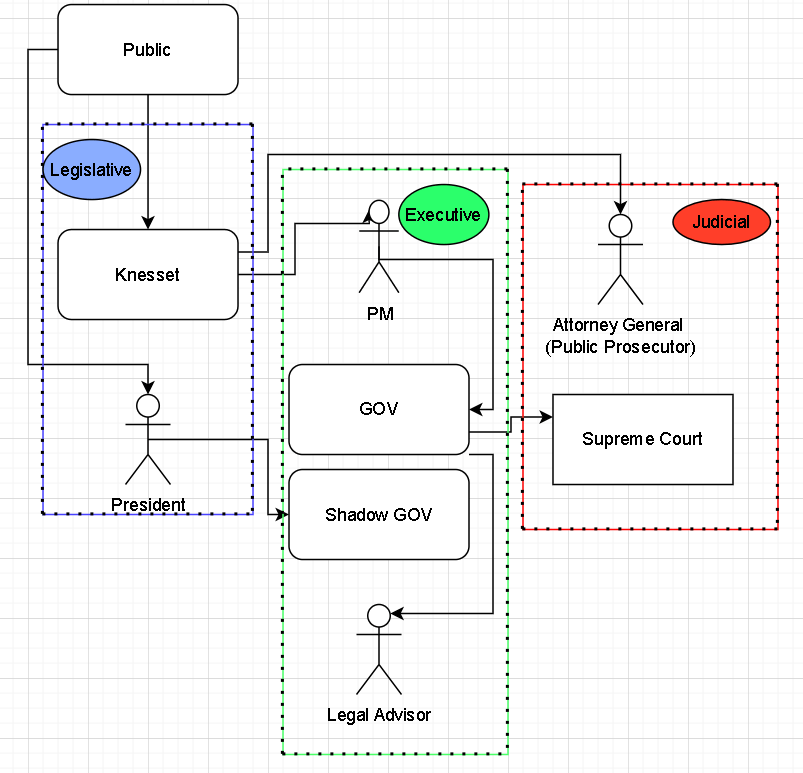
let’s take these two roles and try to separate their powers. First, the PM needs to be in charge of only the executive branch. another public figure will head the legislative branch, similar to the speaker of the house in the U.S. or the speaker in the house of commons in the U.K. But creating a new office with newfound powers is expensive and controversial. what might just work is changing the role of the president of Israel to be just that – head of the legislative branch.
let’s create a feasible model: power flows from the people through a free and fair election to the Knesset and the President. In ordinary times, a coalition government is formed, and together with them, an alternative “shadow government” will be sworn in, and appointed by the president. The shadow ministers will attend meetings and be presented with all of the ministry’s workings. in the event of a budget not passing, a dissolution of parliament or the government, the shadow ministers immediately replace the existing government.
Presiding president
The president and shadow government are a backup, snapped into place in the case a majority in parliament couldn’t be reached. The exiting ministers become the shadow ministers and still get to sit in on all the meetings, just not make the decisions. The same applies to the cabinet. I’ll concede that shadow government isn’t an ideal name and evokes connotations of a deep state conspiracy but in practice, this will divide a concentration of power that prevents a solid separation between legislative and executive.
The attorney general could be handled in the way almost every other western democracy had, with two separate offices of a public prosecutor and a government advisor. that should reduce the tension in that role and provide a conflict-free task for each of them.
In summation:
 Anarchy Guide
Leave a comment